Everything you publish online now has a second user. It's called an AI agent
8 Jun 2026
More and more of the buying decision happens before the customer ever lands on your site. They ask AI, read what the model serves up, compare offers in a chat window. The salesperson hears from them last, once the shortlist of suppliers is already settled in their head. You can argue with this. You can assume manufacturing plays by its own rules. The data says otherwise.
Marketing teams at manufacturing companies are dealing in parallel with another, less obvious shift: who actually consumes the content published online about a brand and its products. In June 2026 Cloudflare reported that automated traffic had, for the first time, overtaken traffic generated by people, 57.5% against 42.5%. So your website, your product catalog and every piece you publish online now have two audiences. Designing a single user journey for a human is already a challenge many manufacturers struggle with. It gets harder when a second scenario shows up alongside it, one you have to think through and design for a user with entirely different, new requirements…
The decision is made in conversation with AI, not with a salesperson
Start with where the game is really played. The data more and more people are citing (the report 'State of B2B Revenue 2026' by AeolusGTM) shows that a buyer enters the purchasing process with a ready list of 4-5 suppliers, and in 95% of cases the winner comes from that group.
The salesperson gets a customer who chose their supplier much earlier. During online research, which is where marketing usually works, not sales.
That research has moved to AI. 73% of B2B buyers prefer to find suppliers and buy online (Sana Commerce, B2B Buyer Report 2025), and 89% use generative AI when choosing a supplier (whitepaper by the agencies Small and Com2Be). And if a user does reach for a traditional search engine, 68% of Google searches now end without a click to any site at all (SparkToro, data for January-April 2026).
In practice, a large part of the customer's decision-making happens during a conversation with a chatbot.
A bad buying process has been sending customers to competitors for years
Before we get to agents, one thing you can see in manufacturing companies and distributors going back years. Customers rarely leave over price alone. More often they leave because the buying process is too frustrating. Sana Commerce reports that 85% of buyers hit barriers caused by outdated systems and inaccurate data, and 75% consider switching suppliers because of it.
It is worth checking on your own turf. Open your catalog or B2B store and see whether the current stock level, delivery date and net price are visible without having to call a salesperson. If they are not, the customer who cannot see them sits squarely in that 75% considering a switch.
How does this connect to AI agents? If a person, someone with empathy, context and a real need, trips over the absence of this data, then an AI agent reading the same page mechanically simply will not see it.
And what it does not see, it will not recommend in a conversation with the customer.
Your content now has a second user
Back to that 57.5% of web traffic generated by bots of various kinds. A second, independent measurement points the same way: in its bot report Imperva sees automated traffic rising from 51% in 2024 to 53% in 2025, and HUMAN Security shows machine traffic now growing eight times faster than human traffic.
AI agents drive this: programs that browse the web on someone's behalf, compare offers and increasingly take action.
Adyen's research shows where this is heading: 42% of consumers would hand an algorithm the entire purchase, payment included. That is still the consumer market, but the same mechanism is already entering B2B buying.
From this comes a conclusion that should shift the priorities of marketing teams in manufacturing companies.
The website, the product catalog and the materials in trade media have stopped having a single audience. Now it is a human and an AI agent, and the agent reads these materials differently. A nice layout tells it nothing. It will not see a price hidden behind an 'ask for a quote' button, and it will not read a spec pasted into a PDF as a downloadable image.
An agent needs data in a structure it can read mechanically: clear specifications, available prices and stock levels, consistent descriptions.
There is also a point you cannot dismiss. As much as 85% of the sources AI bases its answer on are external media and trade press, less often the company's own site (Small, Com2Be). Even a site optimized for visibility in LLMs, which is a must have, may not be enough on its own.
First mover wins
This is the point where someone usually asks for a quick fix. There is not one. Adapting every digital touchpoint so that it is readable and picked by agents is work spread over quarters, not a one-month campaign.
The bad news is that it is a marathon. The good news is that for most manufacturers the race is only just starting, so there is still time to take the lead.
Add one more number from the same AeolusGTM report. At any given moment only about 5% of the market is actively looking for a supplier. The other 95% is not buying now and will not respond to a salesperson reaching out.
Presence in content and in AI answers works precisely on that 95%, because it builds awareness before the buying process starts. And when the process does start, we want to be on the shortlist of possible suppliers in customers' heads, which raises the odds of winning.
A manufacturer that is first to adapt its content and data so agents can read them starts getting cited and recommended in the answers customers build their preferences on for future purchases. Companies that drag their feet will not show up in model recommendations or in customers' minds. The longer they wait, the harder it gets to catch up, because the leader's position will have settled into the algorithms.
Strategy is one thing, execution is another
So how do you approach this sensibly? Here begins the part people talk about far too little, and the part that usually decides the outcome.
Optimizing your website, content, product catalog and data for both humans and AI agents is a sizeable undertaking at the meeting point of technology, UX and communication.
From our experience, internal marketing teams at manufacturing companies are often smaller than their more developed sales counterparts, and they still have to carry the daily grind: constant communication, trade shows, ad materials and so on. Adding a project this multidimensional is a straight path to overloading the team. All the more so because projects like this tend to stall when they do not sit high enough on the priority list and have no one with decision-making authority assigned to them.
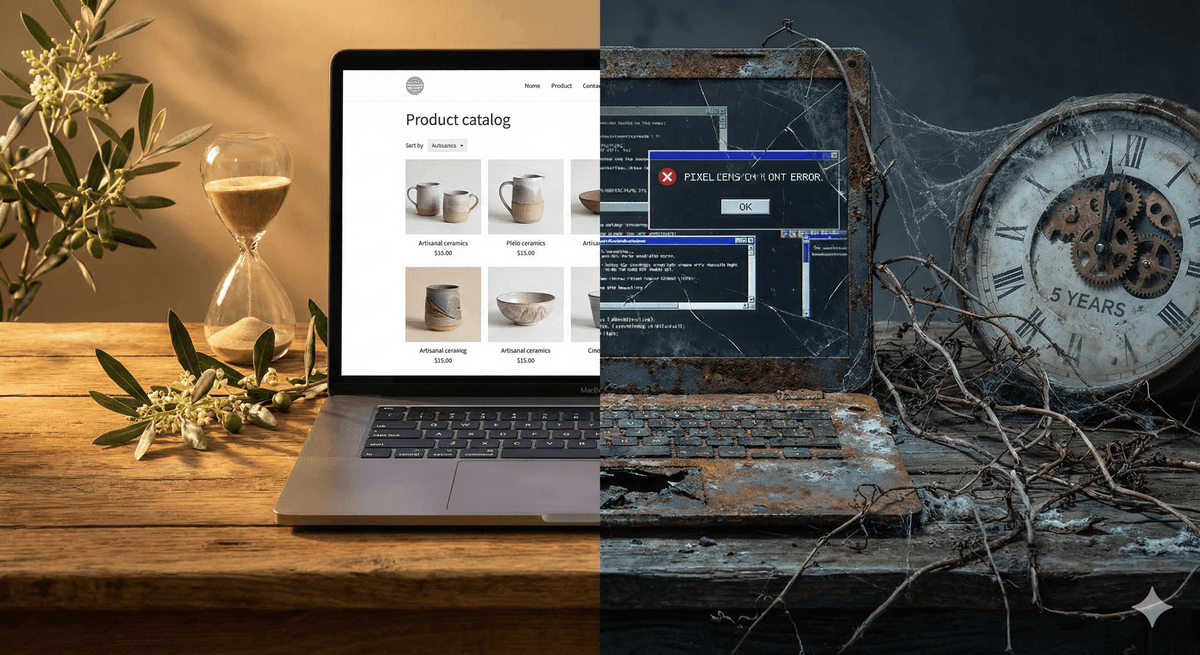
We have seen it up close. We ran two near-identical online catalog projects at two similar manufacturing companies. One launched on time. The other was stuck for five years. It was not technology or budget that decided it, because there the companies were comparable. What decided it was whether the project had a real owner with a mandate to make decisions. We described the whole story, with specifics, here.
Where to start
If you do one thing this week to get closer to being visible in LLMs, I recommend a simple exercise:
Type a question about your industry and product category into ChatGPT or another model, and see who it names, on what basis, and whether your company is there. Then open your own product catalog and check whether the price, availability, specification and likely delivery date can be found without contacting a salesperson.
If you are wondering how to use AI wisely in your company's next stage of growth and you are looking for a partner who understands manufacturing, get in touch. Even if it seems too early to work together, we are happy to share what we know and point you toward the best way to prepare for this new reality for manufacturers.