01.
Too many variants, too little guidance
The customer does not want to read the whole offer. They want to quickly narrow down the choice and understand what fits their situation.
We help manufacturers of complex products organize the information, processes and tools that shape the purchasing decision. As a result, the customer understands the offer more easily, the sales rep sells faster, and support works on the same data.

Experience from projects for companies with a complex offering







Price is not always the reason you lose. Sometimes the customer drops off because they do not understand the differences between variants. They cannot find the documentation. They do not know whether the product fits their use case. They do not get a clear path to an inquiry, or they leave a partner with material that has long been out of date.
The customer does not want to read the whole offer. They want to quickly narrow down the choice and understand what fits their situation.
Marketing, sales, support and partners often use different versions of descriptions, documents and technical data.
When updates, inquiries, materials and data flow through people instead of well-designed tools, the company loses momentum.
Pick the role closest to your situation or switch views to see the same problem from the perspective of marketing, sales and customer support.
We look at the challenges for marketing: the places where the customer loses clarity about the offer, marketing loses publishing pace, and leads reach sales without good context.
An investor, a specialist and a distributor have different needs, but the website does not guide them through tailored content, tools, documents and contact points.
The customer browses products but does not know which variants fit their situation and when it is worth getting in touch.
Every change requires data from the product team, IT support, or manually updating the same information in many places.
The product description, PDF, spec sheet, landing page and sales presentation often show different versions of the same information.
Forms collect contacts but do not show what the customer did earlier and which content, products or campaigns actually helped them move to an inquiry.
For marketing areas we do not start from a feature list. We check where marketing loses clarity, time or control over information, and only then choose a catalog, CMS, automation, analytics or AI.
Personas, entry scenarios, content layout, contact points and materials tailored to an investor, a specialist, a distributor or another audience.
It answers questions, suggests the right content and gathers the context of needs before the user moves on to a form or a conversation with sales.
Categories, filters, applications, comparisons, product cards and documents that lead the customer toward the right inquiry.
Components, landing pages, product content and a workflow that lets you publish without constantly waiting for IT.
A single source of descriptions, parameters, files and materials that helps keep information up to date on the website, in the catalog, in PDFs and in presentations.
Forms, events, CRM and dashboards showing the source, the user journey, downloaded materials and the actions that led to an inquiry.
We do not show our entire portfolio here. We picked a few examples where the problem did not end on the screen: we had to connect the offer, data, integrations and the team’s daily work.
FAKRO drives customers to its catalog straight from campaigns. The problem was simple to describe but hard for the customer: the catalog had complete data, yet the investor still did not know which model was right for them. They were buying a roof window for the first time and knew neither the terminology nor the parameters. So they postponed the decision or drove to a building supply store for advice — and there it was easy to steer them toward another brand. We built a configurator that, instead of a catalog, guides the customer visually through a few questions and ends with a single matched window.
The investor chooses faster and with more confidence, because photos and pictograms guide them, not a table of parameters. FAKRO advises instead of handing that conversation over to distributors and search engines. The entire choice stays on the site, so the brand owns the path and loses fewer customers to competitors. Premium options and accessories appear once the customer has already decided on a window, so the basket value grows and the order is more complete. The configurator itself blocks inconsistent combinations and flags missing parts, so fewer complaints come back after installation.

Elmark, a distributor of industrial automation, for years based part of its processes on advanced Excel workflows. With a large product base, the costs of versioning, updating and controlling data kept growing, so a central tool for working with the offer was needed.
The team got a more controlled way of working with a large offer: less risk of errors, faster updates and a better foundation for publishing, translations and sales channels.
JUKI needed a portal for after-sales and ordering parts. Previously, customers placed orders manually and waited for replies from different branches. The new portal was meant to shorten the path to information and offload the operational teams.
Customers can place orders faster based on real-time availability, and the sales agent checks prices and stock more efficiently without querying the branches.
The goal of the project was to strengthen the brand’s presence and its offer online, and thereby to create an alternative to in-store sales.
A 48% increase in online inquiries while raising their quality at the same time. Leads are embedded in the context of the chosen product and the customer’s needs.
Lorem ipsum dolor sit amet, consectetur adipiscing elit. Mammut, a Swiss manufacturer of mountaineering equipment, needed a consistent online presence for advanced users and retail customers. The project covered digital branding, the product catalog and the purchase flow.
A consistent brand presence across all channels, increased conversion and a better understanding of premium customer behavior thanks to analytics built into the platform from the start.
We will help name the problem, recognize the dependencies and choose the first scope that makes business sense.
45 minutes about your offer, product data and the places where customers, sales reps or partners lose clarity in contact with your brand today.
Book a free consultation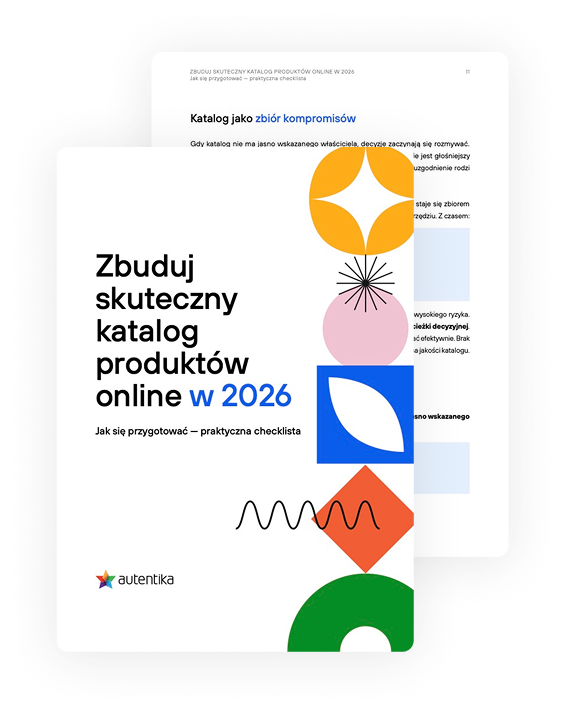
A practical guide for manufacturers planning to refresh a catalog, rebuild product cards or organize product data. See what is worth taking care of before the project starts, so you do not begin with the layout but with the decisions that really affect sales.
How to establish why the catalog is being built, who makes the decisions and how you will know the project succeeded.
How to check whether descriptions, parameters, variants and data sources are ready for a new catalog.
How to design the catalog for different user groups and grow it without losing control over the data.